
On October 19, the Ai & Robots Film Festival sent us its winner’s laurel: Last One won Best Technical AI. The festival had selected the film earlier in October and screened it on October 17, with the filmmakers in attendance.
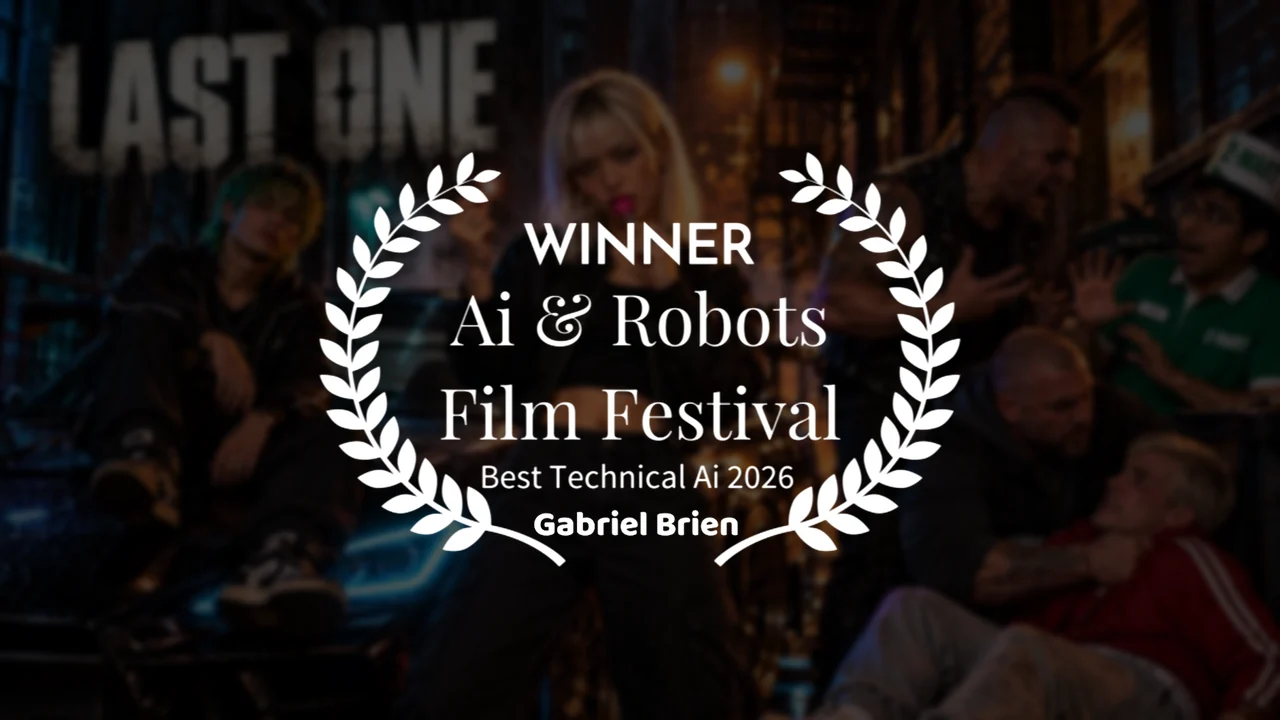
It is the film’s second award in a week. On October 16, AI Independent Montreal gave it The Independent Vision Award, its Grand Prize for best film overall (read the story). One prize judged the film as a story. This one judged how it was built.


Watch the film
Out of candy on a rainy night, Lolly, a young woman who can stop time with a snap of her fingers, walks to the corner store and ends up saving everyone she meets, including the guy who laughed at her.
What “technical” means for a generated film
In live action, a technical award usually goes to the camera, the sound or the effects. In a generated film, a striking shot is no longer the hard part. The technical problem is control: keeping the same face, the same jacket and the same street from one shot to the next, and making the sound, the cut and the light agree with each other for three minutes.
A striking shot proves nothing. Holding three minutes together is the technical work.
The festival did not publish its jury’s notes, so we cannot say how each film was weighed. We can say what the technical work on Last One was.
Where the technical work went
Last One by the numbers
Production, September to October 2026
1
person, from script to final mix
7
sequences, one master prompt each
29
reference images approved
0
frames of filmed footage
Continuity solved before generation. Every character, prop and location was fixed on a reference sheet against a neutral grey background: faces and wardrobe from three angles, props in their different states, locations from four camera positions. The written descriptions were then rewritten from the approved images, which is why a jacket, a scar or a lollipop stays the same from the apartment to the alley.
Each sequence directed as one take. The film is seven sequences of 15 or 30 seconds. Each was written as one master prompt, the way a cinematographer is briefed: one named camera angle per beat, the rhythm in words, no timestamps. Cuts between places are hidden at the instant an object fully covers the lens.
One voice per character. Dialogue was generated with the picture so the lip sync holds, then converted so each character keeps the same voice for the whole film.
The finish done by hand. The edit, sound design, colour grade, titles and animated subtitles were done in a conventional edit, frame by frame.
The full method is in Who Deserves to Be Saved? The Making of Last One.
Why a technical award matters to a brand
A brand film breaks on the same points a short film does: a spokesperson whose face drifts, a label that changes between two shots, a voice that sounds different in the second scene. A technical prize from a jury that watched a full program of generated films says those problems were solved on screen, not in a pitch. It is the method we bring to brand films, spokesperson videos and series.
Where to see it
Last One is online, above and on its watch page. The winners’ screening AI Independent Montreal had planned for October 24 will not take place; the festival plans to show its winners after its next season.
Thank you to the Ai & Robots Film Festival team and its jury.
Press materials
- Last One press kit (web version, with both laurels)
- Download the Best Technical AI laurel (white)
- Watch Last One
- Interview requests

Gabriel Brien
Founder of Crimson Spark Agency. AI filmmaker and creative technologist, writing from running this work daily.
More about Gabriel →