3 tests before you trust a new AI video model.
Spec sheets tell you what a model can do once. These three tests tell you what a shot you can deliver really costs. We run them on every new model, Kling 4.0 included, before it touches client work.
One page, A4, PDF. Free, no sign-up.
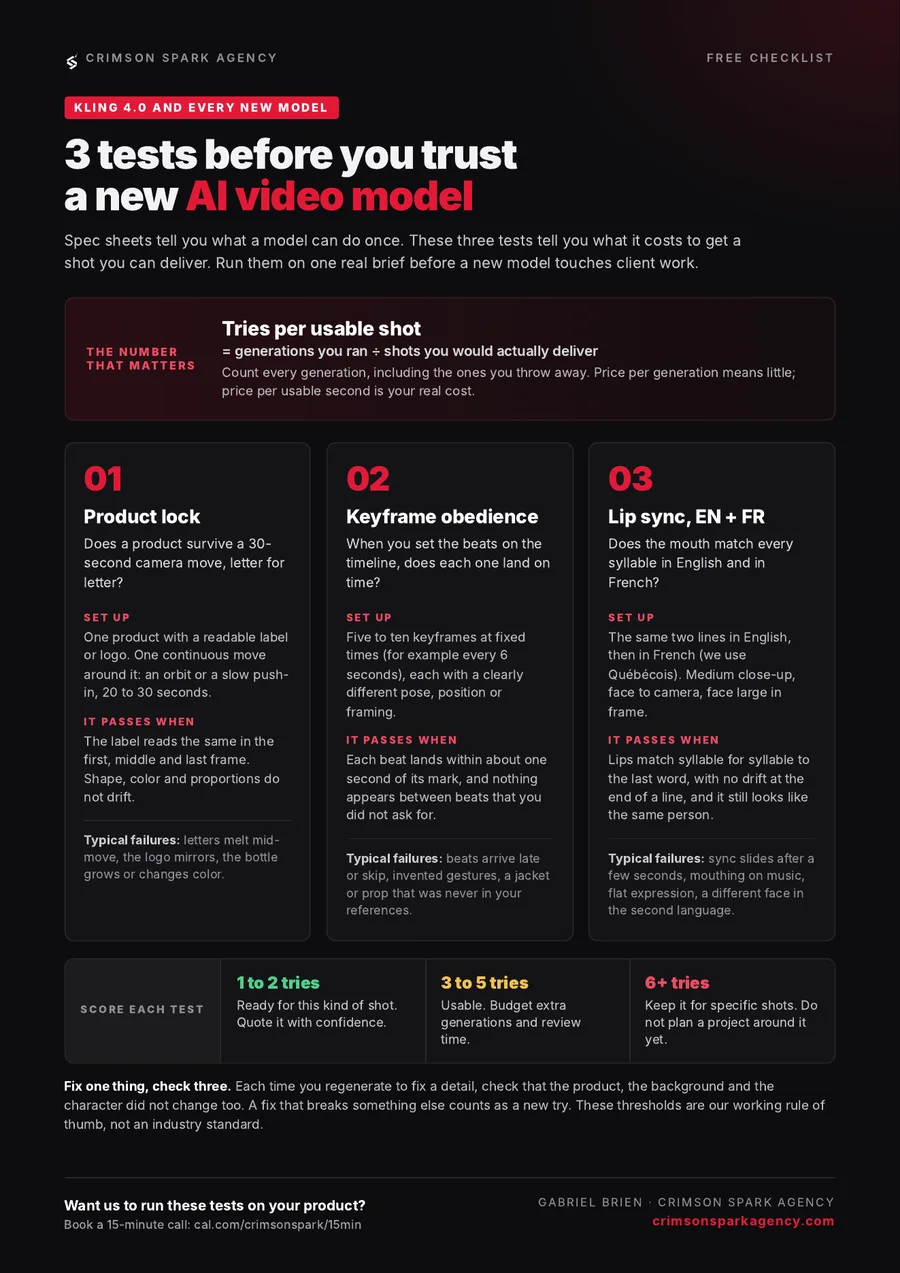
One number decides what a shot really costs.
Count every generation, including the ones you throw away. The price of one generation means little. What a usable second costs you is the real number, and it is the one a client pays for.
Three tests, one real brief.
Run all three on a real product and a real line of dialogue, before a new model goes anywhere near a client project.
- 01
Product lock
Does a product survive a 30-second camera move, letter for letter?
Set upOne product with a readable label or logo. One continuous move around it: an orbit or a slow push-in, 20 to 30 seconds.
It passes whenThe label reads the same in the first, middle and last frame. Shape, color and proportions do not drift.
Typical failures: letters melt mid-move, the logo mirrors, the bottle grows or changes color.
- 02
Keyframe obedience
When you set the beats on the timeline, does each one land on time?
Set upFive to ten keyframes at fixed times (for example every 6 seconds), each with a clearly different pose, position or framing.
It passes whenEach beat lands within about one second of its mark, and nothing you did not ask for appears between beats.
Typical failures: beats arrive late or skip, invented gestures, a jacket or prop that was never in your references.
- 03
Lip sync, EN + FR
Does the mouth match every syllable in English and in French?
Set upThe same two lines in English, then in French (we test in Québécois). Medium close-up, face to camera, face large in frame.
It passes whenLips match syllable for syllable to the last word, with no drift at the end of a line, and it still looks like the same person.
Typical failures: sync slides after a few seconds, mouthing on music, flat expression, a different face in the second language.
Score each test.
Count the tries it took to get one shot you would deliver.
- 1 to 2 tries
Ready for this kind of shot. Quote it with confidence.
- 3 to 5 tries
Usable. Budget extra generations and review time.
- 6+ tries
Keep it for specific shots. Do not plan a project around it yet.
Fix one thing, check three. Each time you regenerate to fix a detail, check that the product, the background and the character did not change too. A fix that breaks something else counts as a new try.
These thresholds are our working rule of thumb, not an industry standard.
Where Kling 4.0 stands.
Kling 4.0 became fully available on October 15, 2026, with 30-second shots, up to 10 keyframes and 15 references. Its API, 10-bit HDR output and the extension to about two minutes were still listed as coming soon at release.
That is exactly when these tests earn their keep: a new spec sheet, and no independent numbers yet on what a usable shot costs.
Want us to run these tests on your product?
Book a 15-minute call. We test on your product, in your language, and tell you which shots a model can carry.